How Do I Describe What I Speak About in One Clear Sentence?
How Do I Describe What I Speak About in One Clear Sentence?
You're at a networking event, on a podcast, or talking with someone who could potentially refer you for a speaking opportunity.
Then they ask:
“So, what do you speak about?”
It sounds like the easiest question in the world.
Until you try to answer it.
Suddenly, you're thinking about every topic you know, every presentation you've delivered, every credential you've earned, and every problem you could possibly help someone solve.
Three minutes later, you're still explaining.
And the other person still isn't quite sure what you speak about.
For experts who know a lot, this is an incredibly common problem.
It's also a costly one.
If people don't understand your message quickly, they won't remember it clearly. And if they can't remember it, they can't easily refer or book you.
The solution is learning to describe what you speak about in one clear sentence.
Your Speaker Positioning Statement Should Be Simple
The goal isn't to make yourself sound impressive.
It's to make yourself easy to understand.
Your one-sentence speaker summary should answer three questions:
What do you speak about?
Who is it for?
Why does it matter?
There's a simple framework you can use:
I speak on [TOPIC] to help [AUDIENCE] [RESULT].
That's it.
Topic. Audience. Result.
Think of this sentence as your clarity compass.
It helps you communicate what you do while also keeping your broader speaker brand focused.
What Does a Strong Speaker Positioning Statement Sound Like?
Here are a few examples:
“I speak on emotional resilience to help healthcare leaders prevent burnout and lead with empathy.”
“I speak on workplace communication to help engineering teams collaborate more effectively across functions.”
“I speak on storytelling to help entrepreneurs grow their businesses by becoming unforgettable.”
Notice what these examples don't include.
There isn't a long list of credentials.
There isn't complicated industry jargon.
There aren't five different topics competing for attention.
Each sentence makes three things clear: the subject, the audience, and the outcome.
That's what makes the positioning memorable.
Step 1: Identify the Topic You Want to Be Known For
This can be surprisingly difficult for experts.
Why?
Because you probably know a lot.
You may be qualified to speak about leadership, communication, resilience, wellbeing, entrepreneurship, innovation, personal development, or several other subjects.
But your one-sentence positioning statement isn't supposed to contain your entire body of knowledge.
It's supposed to help people understand what you most want to be known for.
Ask yourself:
What topic do I want people to associate with my name?
What problem am I particularly qualified to address?
What subject could I speak about repeatedly without losing interest?
What expertise connects most strongly with the speaking opportunities I want?
You aren't necessarily choosing the only thing you'll ever speak about.
You're choosing the clearest doorway into your expertise.
Step 2: Define Who Your Talk Is For
Now consider your audience.
One of the quickest ways to weaken your positioning is to say your message is for “everyone.”
It usually isn't.
And that's a good thing.
Specificity helps people recognize relevance.
Compare:
“I help professionals become better communicators.”
with:
“I help healthcare leaders communicate more effectively during periods of organizational change.”
The second statement makes it much easier for someone to think:
“I know exactly who needs this.”
Specificity Makes You Easier to Refer
Imagine someone hears you speak and loves your message.
A week later, they're talking with a colleague who organizes leadership development programs for healthcare executives.
If your positioning was broad and complicated, they may say:
“I heard this speaker recently. She talks about leadership and communication and some other things. You should look her up.”
But if your positioning was clear, the referral becomes:
“I heard a speaker who helps healthcare leaders communicate through organizational change. You should talk to her.”
That's a much stronger referral.
Your positioning isn't only about how you introduce yourself.
It's about how other people describe you when you're not there.
Step 3: Name the Result You Help Create
The final part of the framework is the result.
This is where many speaker positioning statements become vague.
They use phrases such as:
“To inspire people.”
“To educate leaders.”
“To empower women.”
“To motivate teams.”
Those goals can be meaningful, but they're difficult to visualize.
Ask a more specific question:
What becomes different because someone hears my message?
Maybe you help leaders:
Communicate with greater clarity
Navigate change more effectively
Prevent burnout
Improve collaboration
Build trust
Lead through uncertainty
Advocate for change
Make better decisions
Strengthen team performance
The more clearly you can communicate the outcome, the easier it becomes for an event planner to understand why your talk matters.
Put the Three Pieces Together
Now combine your topic, audience, and result:
I speak on [TOPIC] to help [AUDIENCE] [RESULT].
For example:
Topic: Storytelling
Audience: Entrepreneurs
Result: Become more memorable and grow their businesses
Becomes:
“I speak on storytelling to help entrepreneurs become more memorable and grow their businesses.”
You can refine the wording later.
Start with clarity.
Don't Try to Sound Impressive
One of the most important principles in speaker positioning is this:
If you confuse them, you lose them.
Experts sometimes use complicated language because they want to demonstrate the depth of their expertise.
But complexity doesn't necessarily communicate credibility.
Sometimes it simply creates confusion.
Imagine introducing yourself by saying:
“I speak on transformational leadership methodologies designed to facilitate cross-functional human-centered organizational optimization.”
It may sound sophisticated.
But can someone repeat it five minutes later?
Probably not.
Now compare that with:
“I speak on leadership communication to help managers build stronger, more resilient teams.”
You immediately know what the speaker does.
Clarity wins.
Test Your Sentence Out Loud
Once you've written your positioning statement, don't leave it on the page.
Say it.
Your sentence needs to work in conversation, not just in website copy.
Try it when someone asks what you do.
Share it with someone unfamiliar with your business.
Then ask them:
“What do you think I speak about?”
If they can explain it back to you accurately, your positioning is probably clear.
If they look confused or interpret it completely differently, keep refining.
Your One Sentence Can Anchor Your Entire Speaker Brand
This exercise isn't only about answering questions at networking events.
A strong positioning statement can become the foundation for multiple speaker assets.
You can use or adapt it for your:
Speaker one-sheet
Website headline
Speaker reel
LinkedIn profile
Podcast introduction
Speaker bio
Event pitches
Social media profiles
That consistency matters.
When someone encounters you in several places, they should receive a similar message about what you do and who you help.
Over time, that repetition strengthens your positioning.
A Real-World Example: From Broad to Bookable
Imagine an entrepreneur describes her speaking this way:
“I speak about leadership, confidence, personal growth, communication, mindset, and helping women reach their potential.”
There's nothing inherently wrong with those topics.
But the positioning creates a problem.
What would you book her to speak about?
Who specifically needs her message?
What result should the audience expect?
Now imagine she refines the sentence:
“I speak on leadership confidence to help women executives communicate with authority in high-stakes environments.”
Now we have clarity.
We know the topic.
We know the audience.
We understand the potential outcome.
She hasn't necessarily abandoned everything else she knows.
She's simply made it easier for someone to understand where her expertise fits.
And that's what effective speaker positioning should do.
Your Actionable Takeaway
Write these three words on a page:
TOPIC
AUDIENCE
RESULT
Under each one, write your answer.
Then put them together:
“I speak on __________ to help __________ __________.”
Say it aloud.
Remove unnecessary words.
Remove jargon.
Then test it with someone who doesn't already understand your work.
Your goal isn't to create the cleverest sentence.
Your goal is to create one that someone else can understand, remember, and repeat.
Turn Your Positioning Into a Bookable Speaker One-Sheet
Once you've clarified what you speak about, that positioning needs to show up consistently in the materials event planners use to evaluate you.
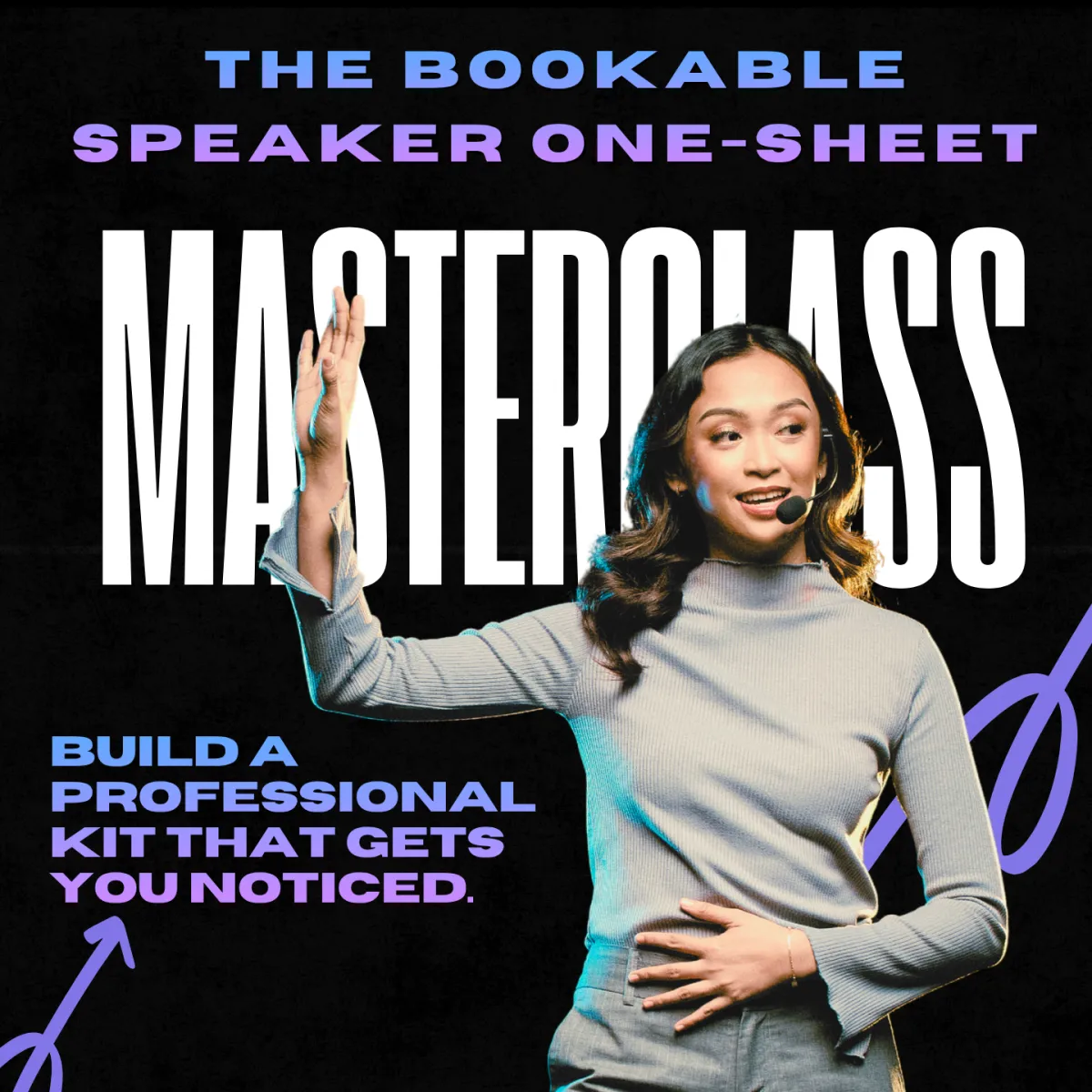
That's why I created The Bookable Speaker One-Sheet Masterclass: Build a Professional Kit That Gets You Noticed.
You'll learn how to position yourself with confidence, create a strong speaker one-sheet even if you're new, and make simple upgrades that help you look more professional to event planners and decision-makers.
Register here: https://successthroughspeaking.com/onesheetmasterclass
Closing Thought
You don't need to explain everything you know for people to recognize your expertise.
You need to make the right thing clear.
When people can understand your message in one sentence, they can remember it, repeat it, refer it—and potentially book you for it.