How Do I Write a Short Speaker Bio That Positions Me as an Authority?
How Do I Write a Short Speaker Bio That Positions Me as an Authority?
You’re asked to submit a short bio for a conference, podcast, panel, or speaking opportunity.
You open a blank document and start typing.
Your degrees.
Certifications.
Job titles.
Awards.
Organizations.
Twenty years of career history.
Before you know it, you have three paragraphs—and the person reading them still may not understand why you’re the right expert for this particular opportunity.
Here’s the problem:
Your short bio isn’t a background summary. It’s a positioning tool.
Its job isn’t to tell people everything you’ve done.
Its job is to quickly establish why your expertise matters, who you serve, and why you are a credible voice on your topic.
For speakers, coaches, consultants, authors, entrepreneurs, executives, and other subject matter experts, that distinction is important.
Here's how to write a short bio that positions you with authority without turning it into a condensed résumé.
Why Your Speaker Bio Matters
Your bio may feel like a small part of your speaker marketing materials, but it can carry significant weight.
An event planner may read it while deciding whether to consider you.
A conference organizer may use it to introduce you.
A podcast host may read directly from it before your interview.
A prospective client may see it on your website before deciding whether to contact you.
In each case, your bio is shaping someone's perception of your expertise.
The question isn't:
“Did I include everything I've ever accomplished?”
The better question is:
“Does this bio make it clear why I'm a credible and relevant expert for this audience?”
A strong short bio usually needs three essential elements.
1. Lead With Credibility, Not Chronology
Many professional bios begin at the beginning.
Where you studied.
What degree you earned.
Where you worked first.
What happened next.
That's how a résumé works.
It's usually not how a strong speaker bio should work.
Instead, begin with what establishes your authority right now.
Your opening sentence should give the reader an immediate reason to pay attention.
For example:
“Marcus Bell is a leadership consultant, bestselling author, and former Fortune 100 executive who helps organizations build teams that perform under pressure.”
In one sentence, we know what Marcus does, we have credibility indicators, and we understand the general value of his work.
Compare that with:
“Marcus holds a degree in Organizational Leadership and has worked in various industries over the past 25 years.”
That information may be true.
But it doesn't position him nearly as effectively.
Choose Your Strongest Credibility Anchors
Your credibility anchor could include:
Your current professional role
Relevant industry experience
A meaningful credential
A significant leadership role
Author credentials
Speaking accomplishments
Original research
Recognizable organizations you've worked with
A measurable result connected to your expertise
The goal isn't to stack as many credentials as possible.
Choose the ones that make your relevance to the topic obvious.
Authority comes from relevance, not volume.
2. Clearly State What You Do and Who You Help
Once you've established credibility, help the reader understand where your expertise creates value.
Who do you serve?
What problems do you help solve?
What changes because of your work?
For example:
“He works with tech founders, nonprofit leaders, and corporate teams to strengthen culture, retain top talent, and lead with clarity in uncertain times.”
Now the reader understands not only who Marcus is but also who benefits from his expertise.
This is particularly important for speakers.
Event planners aren't evaluating your credentials in isolation.
They're trying to determine:
Is this person relevant to my audience?
Make the answer easy to find.
Don't Try to Be Relevant to Everyone
Specificity strengthens positioning.
If you primarily work with healthcare executives, say so.
If your expertise is helping female founders communicate with greater authority, name them.
If you speak to HR leaders about supporting working caregivers, make that clear.
A bio that tries to appeal to everyone can become so broad that no one immediately recognizes themselves in it.
You don't need every reader to think:
“This speaker is for me.”
You need the right reader to think:
“This is exactly the expertise our audience needs.”
3. Add a Human or Mission-Aligned Detail
Authority doesn't require sounding impersonal.
In fact, one carefully chosen personal or mission-driven sentence can make a short bio much more memorable.
For example:
“His approach is shaped by his years leading through crisis—and his belief that leadership starts with how we treat people on the hardest days.”
That sentence gives us something credentials alone cannot.
Perspective.
It helps explain not only what the expert does but also why the work matters to them.
Keep the Personal Detail Relevant
You don't need to include your entire personal story.
Instead, choose one detail that adds depth to your professional positioning.
It might reflect:
A lived experience that shaped your work
A professional turning point
A belief that guides your approach
A mission connected to your expertise
An unusual perspective you bring to the topic
The best personal details strengthen the reader's understanding of your work rather than distracting from it.
Put the Three Elements Together
Your short bio now has a simple structure:
Credibility + Relevance + Human Connection
First, establish why you're qualified.
Then explain what you do and who you help.
Finally, give the reader a glimpse into the perspective or mission behind your work.
You don't need a complicated formula.
You need every sentence to have a purpose.
What Should You Leave Out of a Short Speaker Bio?
Writing a strong bio isn't only about knowing what to include.
It's also about knowing what to remove.
Don't List Every Credential
Your reader doesn't need every certification you've earned.
Choose the credentials that reinforce your authority on the subject you're being asked to address.
Avoid Empty Descriptors
Words such as “passionate,” “seasoned,” “dynamic,” and “inspirational” are easy to write but don't necessarily prove anything.
Instead of telling people you're an experienced leader, show them through your accomplishments or roles.
Instead of calling yourself an engaging speaker, use evidence that establishes your speaking credibility.
Show authority rather than labeling yourself authoritative.
Don't Tell Your Entire Career Story
A short bio isn't the place to explain every professional transition.
Give people what they need to understand your expertise today.
Don't Bury the Most Important Information
If your strongest credential appears in sentence seven, you've waited too long.
Lead with what matters.
How Long Should a Short Speaker Bio Be?
For many speaker materials, a short bio of approximately 150 to 200 words gives you enough room to establish credibility without overwhelming the reader.
But don't focus only on the word count.
Focus on efficiency.
Ask of every sentence:
Does this strengthen my positioning?
If the answer is no, consider removing it.
A 120-word bio filled with relevant information can be more effective than a 200-word bio padded with unnecessary credentials.
A Real-World Before-and-After Example
Imagine a consultant's bio begins like this:
“Marcus Bell has worked in business for more than 25 years. He holds a bachelor's degree in organizational leadership as well as several professional certifications. Throughout his career, he has worked in numerous industries and held a variety of leadership roles.”
There's nothing necessarily wrong with the information.
But the reader has to work to understand why Marcus matters.
Now consider:
“Marcus Bell is a leadership consultant, bestselling author, and former Fortune 100 executive who helps organizations build teams that perform under pressure. He works with tech founders, nonprofit leaders, and corporate teams to strengthen culture, retain top talent, and lead with clarity through uncertainty.”
The second version positions first and explains second.
That's the shift.
Don't make readers assemble your authority from a list of facts. Position it for them.
Your Short Bio Should Work Across Your Speaker Brand
Once you've created a strong core bio, you can adapt it for different contexts.
It can appear on your:
Speaker one-sheet
Website
Conference program
Event page
Podcast guest profile
Speaker proposal
Media materials
You may need slightly different lengths for different platforms, but your core positioning should remain consistent.
That consistency helps build recognition.
If someone sees your website, receives your one-sheet, and later reads your conference bio, they should encounter the same essential positioning.
Your Actionable Takeaway: Use the Three-Part Bio Test
Pull up your current short bio and review it using three questions:
1. Credibility: Does my first sentence immediately establish why I'm qualified?
2. Relevance: Does the reader know what I do, who I serve, and why my work matters?
3. Connection: Is there a brief detail that communicates my mission, perspective, or reason for doing this work?
Then start cutting.
Remove credentials that don't strengthen your positioning.
Replace vague adjectives with evidence.
Move your strongest credibility anchors toward the beginning.
Keep the final version focused and easy to scan.
Most importantly, make sure your bio sounds like the expert you are today, rather than a chronological summary of everything you've done to get here.
Turn Your Bio Into a Stronger Speaker One-Sheet
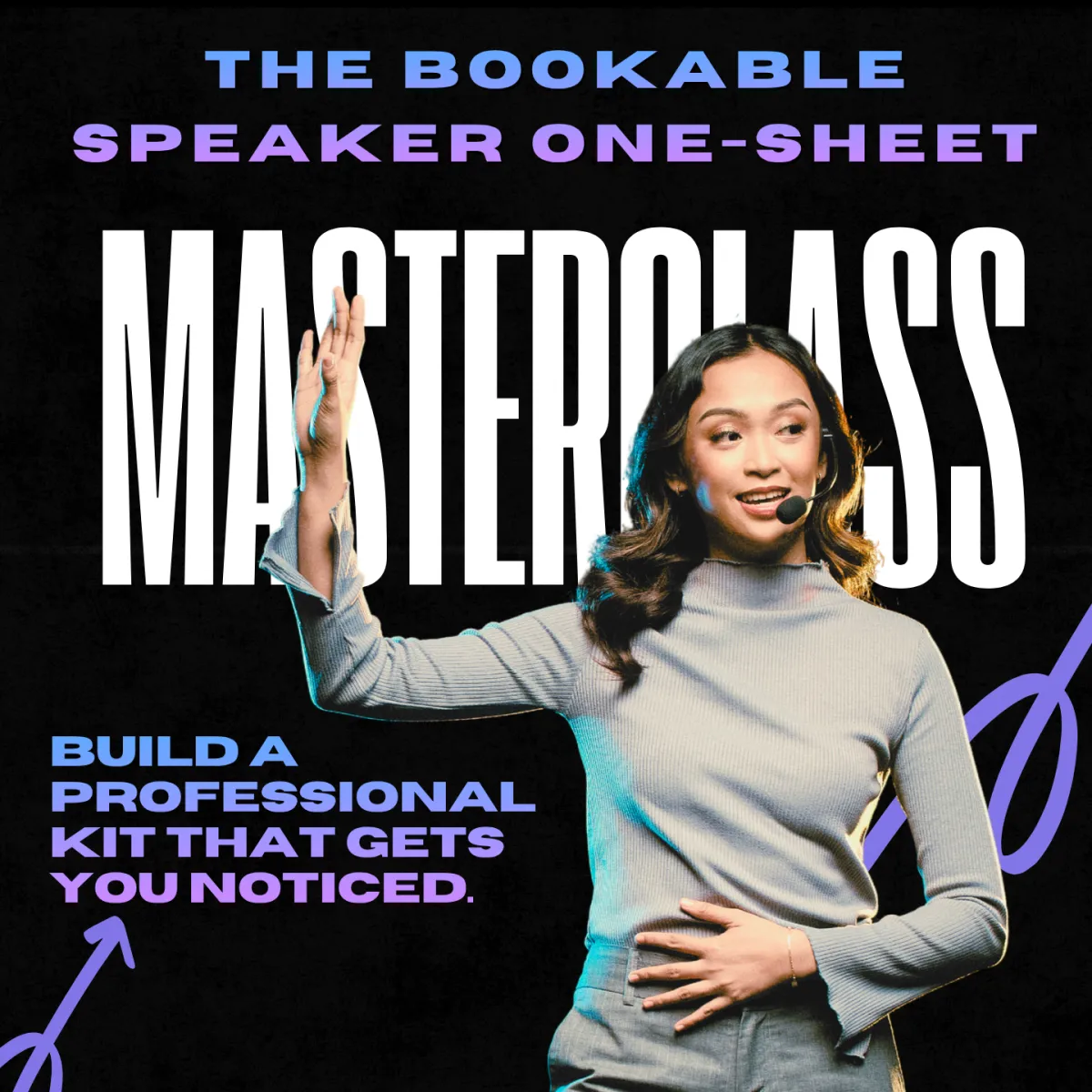
Your short bio becomes even more powerful when it's part of a speaker one-sheet that clearly positions your expertise, topics, and credibility for event planners.
That's why I created The Bookable Speaker One-Sheet Masterclass: Build a Professional Kit That Gets You Noticed.
You'll learn:
How to position yourself with confidence
How to create a strong one-sheet even if you're new
Simple upgrades that make you look more professional
Register here: https://successthroughspeaking.com/onesheetmasterclass
Closing Thought
Your short bio doesn't need to tell people everything about you.
It needs to tell them the right things about you.
Lead with credibility. Establish relevance. Add a human connection.
Then let every sentence reinforce one message:
This is an expert worth listening to.